



The Other Project: Managing the Contractual Obligations that come with Major Project Delivery
A major project and the structures used to deliver it carry complex contractual and corporate obligations that are rarely planned, resourced or managed.
Why does this happen and what can be done about it.
Every major project builds two things: the physical asset, and the temporary organisation that delivers it. The contract underpinning both is drafted primarily to govern delivery of the asset, but it also imposes a substantial body of legal, corporate and reporting obligations on the delivery entity — obligations distributed across clauses, schedules and incorporated documents. This paper examines how those obligations are typically managed, the cost of failing to do so, and what the industry could do differently.
By Brent Boden,
September 2026
Executive Summary
Every major project builds two things: the physical asset and the temporary organisation that delivers it. The contract underpinning both is drafted primarily to govern delivery of the asset, but it also imposes a substantial body of legal, corporate and reporting obligations on the delivery entity — obligations distributed across clauses, schedules and incorporated documents. This paper examines how those obligations are typically managed, the cost of failing to do so, and what the industry could do differently.
In every practical respect, a major project delivery entity operates as a company, whether or not it is incorporated as one. It assumes employer obligations, insurances, licences, accreditations, statutory reporting duties, and community commitments; sets up the whole apparatus within months of award; and dissolves it at completion. The obligations attached to that entity are numerous, largely unrelated to the physical works, and rarely priced.
Two features of the Australian market compound the problem. Major project contracts are drafted afresh almost every time, so obligations appear in different forms, locations and wording on each project, and the organisation responsible for discharging them is itself new. Meanwhile, obligations are hardening: commitments that were policy expectations a decade ago now carry payment consequences, civil penalties, criminal exposure and market access risk, while management systems have not kept pace.
The visible cost of failure is regulatory and modest. The higher cost is unplanned remediation — work converted from planned to unplanned, run out of sequence, and on someone else’s timetable — and it is neither reported nor measured.
The response is two-fold. Within the project, obligations need the same discipline as the works: extracted, owned, rated, resourced, scheduled and verified, with delivery-linked obligations in the master schedule and reporting obligations reviewed at the senior leadership level. Across the industry, the opportunity lies in moving towards standard form contracts such as NEC4 and, more importantly, in establishing a standardised, published reference library of obligations that can be reused and validated across projects rather than being rebuilt from scratch on every project.
1. Two Projects, One Contract
A project delivery entity is often a company in everything but status, created from nothing by an instrument that is bespoke almost every time.
A major project has two problem statements. The first concerns the scale and speed at which a delivery organisation must be created. The second concerns the nature of the instrument that underlies its creation. Together, they explain why a class of binding obligations is routinely reacted to rather than planned and managed, on projects that are otherwise well run.
Consider the first. A delivery entity set up to manage a $2 billion project is a company in everything but name. It employs hundreds of people and carries the payroll, tax and industrial relations obligations that follow. It holds insurances, security and undertakings. It obtains and maintains licences and accreditations, some of which are conditions of being permitted to work at all. It runs procurement, information, and records systems; owes duties to a regulator, a community, an operator, and a funder; and reports to several of them monthly, quarterly, and annually. It does all of this within months of award, staffed by people who bring the habits of their last project and, while regularly briefed on the new project’s scope, are rarely briefed on the contractual framework or underlying obligations. No ordinary company is established that fast, and none is dissolved so soon after reaching operating maturity.
The form that entity takes also varies from project to project. Where delivery is through an incorporated joint venture or a special purpose vehicle, the obligations attach directly to that company: it has directors, files accounts, holds licences, employs people and signs subcontracts. Where the vehicle is an unincorporated joint venture or an alliance, there is no separate legal person, and the obligations remain with the parent companies. The project organisation still has to discharge the obligations, which means collecting the data, running the process, and producing the evidence on behalf of parents whose thresholds, reporting cycles, and corporate policies may differ. Either way, the practical task is the same: the project must reassess its processes, subcontracts and policies to ensure the obligations are met, whether it holds them directly or indirectly.
Now consider the second. In Australia, the contract that creates this entity is almost always bespoke. There is lineage — agencies reuse precedents and practitioners recognise familiar structures from one deed to the next — but effectively no two major project contracts are alike, and that extends to how obligations are drafted. The same statutory requirement appears in a different clause, in a different schedule, with different wording and a different trigger on each project.
The combined effect is that many obligations are (re)discovered rather than planned: at an audit, at an unannounced inspection, after a notification event, or — most expensively — at handover. By then the activity that should have been scheduled and resourced eighteen months earlier has to be improvised by whoever is available.
“Obligations attached to the delivery entity are as binding as the works, and considerably less visible.”
1.1 Definitions
Two terms are used throughout and are defined below.
| Requirement | Any specific provision, standard or expectation set out in the contract or a related regulatory framework that must be met. Requirements encompass technical specifications, operational standards, reporting frameworks and procedural guidelines. |
| Obligation | A binding duty or commitment that a contracting party is contractually or statutorily required to fulfil. Obligations are enforceable, carry accountability, and typically have a defined timeframe and a consequence for non-compliance. |
Obligations in this sense fall into two types, and the distinction runs through the rest of the paper.
- Type 1 — delivery-linked. Tied to the physical delivery and operation of the project and required by a specific date or milestone: conditions precedent, and matters to be satisfied before commencement of construction, before practical completion or before commencement of operations. These are fundamental to delivering the project scope and should be managed as such.
- Type 2 — reporting and event-linked. Triggered by an event or a calendar: a notice within a stated number of days of an occurrence, a monthly or quarterly report, an annual statement, a periodic audit or certification. These behave like recurring commitments and need a cadence, an owner, a process for compiling the evidence and a record.
Despite the differences, both require deliberate management. The following sections examine what these obligations look like in practice, the cost of failing to meet them, and how to capture and manage them.
2. The Obligation Landscape
The obligations attaching to a major project entity fall into nine categories, from accreditation and licensing through industry participation, corporate and entity obligations, reporting, records, interfaces and handover. Appendix A sets these out, with typical instruments, the function that usually holds them, and how each is typically mismanaged. Three patterns from the table frame the following.
- First, aside from the work itself, these categories rarely appear in the work breakdown structure. They seldom carry a budget line or a schedule activity, and on many projects the only evidence they exist is a spreadsheet maintained by one person.
- Second, the health, safety and environment function often absorbs obligations by default. It is generally the only project function with mature compliance machinery, so unallocated obligations often drift there regardless of subject matter.
- Thirdly, obligations of any substance are rarely discharged by a single act. Most require the project to establish and then operate a documented process — procedures, workflows, a records regime, an internal review cycle and a reporting output.
When these patterns are viewed against the evolving landscape of legislation and corporate reporting, the risks and exposure of non-compliance increase. Over the past five years, not only has the number of obligations changed, but their weight has too. The panel below lists six that have come into effect or been materially strengthened since 2021, each of which bears directly on a major project delivery entity in Australia.
| Obligation | In effect | Instrument | Consequence for the project entity |
|---|---|---|---|
| Modern slavery due diligence in public procurement | 1 Jan 2022 (NSW duty); 1 Jul 2026 (mandatory tender clauses) | Modern Slavery Act 2018 (NSW); Public Works and Procurement Act 1912 (NSW); NSW Procurement Board Direction PBD-2025-05 | Heightened due diligence obligations flowed down through the deed; evidence demanded when the client agency is audited. Commonwealth failure-to-prevent offence proposed July 2026. |
| Psychosocial hazards and positive duty on sexual harassment | 1 Oct 2022 (NSW WHS Regulation); 12 Dec 2023 (AHRC enforcement) | Work Health and Safety Amendment Regulation 2022 (NSW); Sex Discrimination Act 1984 (Cth) positive duty | Express duty to identify, control and review psychosocial risks; positive duty to eliminate sexual harassment, enforceable by the Commission. |
| Industrial manslaughter (Commonwealth) | 1 Jul 2024 | Work Health and Safety Act 2011 (Cth), as amended by the Closing Loopholes reforms | Criminal offence for a PCBU or officer whose conduct causes a death; most states now have an equivalent. |
| Wage theft and labour hire | 1 Nov 2024 (labour hire orders); 1 Jan 2025 (criminal underpayment) | Fair Work Act 2009 (Cth), Closing Loopholes amendments | Intentional underpayment a federal crime; fines of the greater of $7.825m or three times the underpayment; regulated labour hire arrangement orders available from the Fair Work Commission. |
| Mandatory climate-related financial disclosure | Periods from 1 Jan 2025 (Group 1); 1 Jul 2026 (Group 2) | Corporations Act 2001 (Cth); AASB S2 | Group 2 captures entities meeting two of: $200m revenue, $500m assets, 250 employees — most tier one and tier two contractors and many joint venture parents. Disclosures subject to assurance. |
| Local content | 1 Jul 2026 | Local Jobs First Act 2003 (Vic), as amended 2025 | Local Industry Development Plan commitments binding; contingent payment mechanisms in contracts; deprioritisation for future government work; civil penalties for non-compliance with Commissioner notices. |
Swipe sideways to view the full table on smaller screens.
The following warrant closer examination, not because they are the most onerous, but because they most clearly show how the ground is shifting. Each began as an expectation rather than an enforceable duty, and each has since acquired a mechanism — a payment consequence, a criminal offence, or a contractual due diligence obligation. Each also operates independently of delivery performance: a project can be on programme and on budget and still fail an underpayment audit, or lack evidence of supplier due diligence.
Modern slavery. The Commonwealth regime has been a disclosure regime since 2019, with no penalty for failing to report. In July 2026, the Commonwealth announced a criminal offence for failing to prevent modern slavery for entities with consolidated revenue above $100 million, with a reasonable steps defence. Since 2022, NSW has imposed mandatory due diligence duties on public entities, which flow down through their contracts and are now being audited. A reasonable steps defence is an evidentiary standard, and the evidence it requires is exactly what an obligation register with verification processes provides.
Local content. Victoria’s Local Jobs First reforms make Local Industry Development Plan commitments binding, require agencies to include contingent payment mechanisms in project contracts, and, from 1 July 2026, allow the Commissioner to deprioritise suppliers for future government work where they fail to meet their reporting or plan commitments, with civil penalties for non-compliance with the Commissioner’s notices. Payment, penalties and market access are the three levers that shape contractor behaviour, and all three are now attached to an obligation that a decade ago was a throwaway tender returnable.
Climate disclosure. Mandatory climate reporting reached Group 2 entities for financial years beginning on or after 1 July 2026 and reaches Group 3 from 1 July 2027, capturing entities that meet two of three tests — $50 million revenue, $25 million gross assets, or 100 employees. Direct emissions and those from purchased energy are required from the first reporting year; emissions across the supply chain follow in the second. For a contractor, that is where almost all of the total sits, in the concrete, steel and subcontracted works it buys. The reporting entity does not hold that data, and many of the suppliers who do are below every threshold and have no obligation to measure anything. The only route is the subcontract. Directors declare the result, the disclosures are subject to assurance, and ASIC can direct corrections without commencing proceedings — yet most of the companies now coming into scope have neither a process for collecting the data nor a contract that requires anyone to provide it.
Climate Disclosure
Mandatory climate reporting reaches Group 3 companies for financial years beginning on or after 1 July 2027
Group 3 Threshold
Revenue threshold bringing a company into scope, on meeting two of three size tests
None of these obligations is new in kind. What has changed is that each now carries a mechanism, and mechanisms are indifferent to good intentions.
3. What Non-Compliance Costs
The cost of non-compliance divides into what the industry can see and what it never measures. The second is the larger of the two.
The costs of non-compliance with these obligations are real and not insignificant, but they are rarely reported, rarely declared, and effectively never in the public domain. Contractual abatements, withheld payments, extended audits, and negotiated rectification are settled confidentially between the parties. The industry’s shared understanding of the cost of non-compliance is therefore drawn almost entirely from the one category of obligation that is enforced in public.
Safety and environmental breaches are prosecuted and published; planning and environment regulators maintain public registers of penalty notices, prosecutions and enforceable undertakings. These breaches often stem from failing to follow a documented process rather than from physical harm — measures not implemented before work started, a plan not published, a record not kept.
The point is that the same failure mode — an obligation documented, allocated and then not managed — applies to the subtler obligations in Appendix A: a planning consent that was overlooked, the accreditation that was applied for late. Those failures appear on no public register. They surface in a client audit, a payment dispute or an operator’s refusal to accept an asset, and they are resolved quietly, at cost, by the party that failed to plan for them. That is where the exposure sits, and where the opportunity for a more disciplined approach lies.
If the visible cost is the penalty, the hidden cost is what happens in the weeks after the failure to comply with the obligation is identified. Whilst it is seldom measured, the consequences can be stated as follows.
- Conversion to unplanned work. A planned obligation can be resourced efficiently. A (re)discovered obligation ends up being resourced, usually at a premium, by additional or external resources that weren’t budgeted.
- Loss of sequencing control. Remediation and recovery run on the regulator’s or the client’s timetable rather than the project’s, adding ad hoc, unplanned work.
- Out-of-sequence rework. Remediation disturbs work already complete — management plans reissued, documents re-approved, subcontractors re-briefed, approvals reopened.
This describes how the costs arise, rather than quantifying the impact. The industry has no figure or benchmark for the cost of managing the obligations as a share of project management cost.
The next two sections set out what a deliberate approach looks like — first capturing the obligations, then managing them.
4. Capturing the Obligations
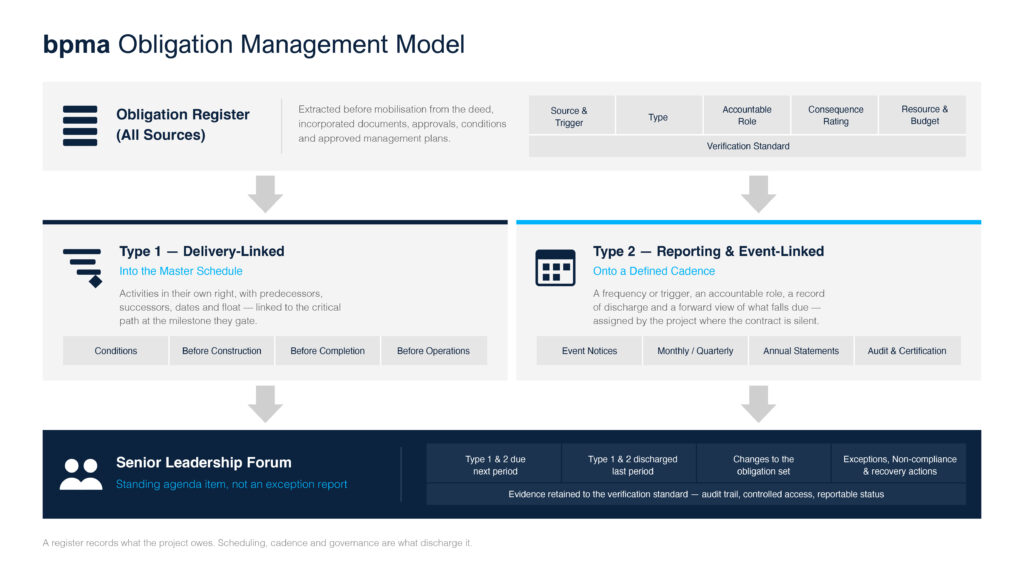
Capturing obligations means producing a single register that identifies every binding duty the project entity holds, regardless of source, and assigns to each the attributes needed to manage it. The two types identified in section 1 are distinguished at the point of capture because they will be managed differently: Type 1 obligations will be scheduled; Type 2 obligations will be placed on a cadence. Six steps produce a register fit for that purpose.
Steps 1 to 3: Building the Record
- 1. Extract. Build the register from the deed, incorporated documents, approvals and conditions, approved management plans and applicable policy instruments. The contract is not the only source and is frequently not the largest. Extract before mobilisation.
- 2. Classify. Assign each obligation to Type 1 or Type 2, record its source and trigger, and map it to a category in Appendix A. Classification determines where the obligation will live and exposes those whose trigger is undefined, which are the ones most likely to be missed.
- 3. Attribute. Assign one accountable role per obligation — a position, not a legal entity — with a named contributing function. A register that records the contracting party as owner has allocated nothing. Ownership disputes surface here, and that is the value of the step.
Steps 4 to 6: Making It Usable
- 4. Rate the consequence. Record the cost of failure across three tiers: termination or licence to operate; financial or payment; reporting or reputational. Deeds are rarely explicit, so the project makes the assessment. You cannot prioritise an obligation with undefined consequences.
- 5. Resource and budget. Give each obligation, or group of obligations, a role, an allocation and a cost line. The roles the market persistently under-resources are the obligations manager, approvals coordinator, industry participation lead and records manager. The organisation reads an unfunded obligation as a low priority.
- 6. Set the verification standard. Define what evidence demonstrates compliance and how deeply it will be tested, scaled to the consequence tier. A document sighting is adequate for the third tier and inadequate for the first. A register without a verification standard records intent, and “in progress” persists in it indefinitely.
A register built this way tells the project what it owes, to whom, by when, at what risk, and how it will know. Ensuring that anything happens is the subject of the next section.
5. Managing the Obligations
A register records what the project must achieve, but recording is not managing. These obligations sit outside the processes through which a project is typically run — the schedule, the monthly report, and the leadership agenda — and until they are integrated into the project’s management system and its governance structures, the register remains just a document rather than a control.
Four moves convert the register into a control.
1. Put Type 1 Obligations in the Master Schedule
Type 1 obligations belong in the master schedule as activities in their own right, with predecessors, successors, dates and float, and are linked to the critical path where the milestone they gate sits. A delivery-linked obligation that exists only in a register has no logic, no float and no owner in the plan that the project actually runs to, which is why it surfaces late and out of sequence.
2. Put Type 2 Obligations on a Defined Cadence
Type 2 obligations need a defined cadence or trigger, an accountable role, a record of discharge and a forward view of what falls due. Where the contract states a frequency, one is assigned; where it does not, the project assigns one, because an obligation without a cadence has no calendar entry, no prompt and no evidence trail.
3. Review Both at Senior Leadership Level
Both types should be reviewed in senior leadership forums as a standing agenda item rather than an exception report: which Type 1 obligations fall due in the next period and whether they are on track, which Type 2 obligations were discharged in the last period and which were not, and what has changed in the obligation set. Including obligation reporting in the project's governance framework turns a register into an effective management tool. It also addresses the failure regulators repeatedly identify when reviewing procurement frameworks: each party in a chain assumes the party above has done the work, and nobody discharges the obligation.
4. Tools of the Trade: Configure What You Already Have
Standard project management processes handle a traditional set of tasks well — certifying payment claims, administering variations, project controls reporting. The obligations described in this paper differ in origin: most are normally applied to a corporate entity rather than a project and have never formed part of the traditional project management suite. Hence, obligations must be identified and processes designed and implemented on a project-by-project basis, aligned to the project's own structure, interfaces and systems.
These processes need to be integrated into the project's management system and aligned with the governance arrangements described above. In most cases, the tools are already in place. A common data environment (CDE), such as Oracle Aconex, already routes submissions, records approvals, and manages correspondence and document control — the obligation processes can be configured within the CDE. The configuration effort should be planned and resourced, but it will provide an audit trail, controlled access, and reportable status.
Artificial intelligence is also useful at the front end — for first-pass extraction across long document sets, classification, cross-referencing a deed against approval conditions, and detecting changes when a plan is reissued — but extraction is a drafting aid rather than a legal opinion. Every extracted obligation needs expert verification before it enters the register. Verification, finally, has to mean testing rather than collecting: a subcontractor's assurance is not evidence, and a project that accepts self-declaration signals to its supply chain that denial is the safe answer.
A register without an owner, a budget line and a verification standard records intent, not control.
With obligations in the schedule, on a cadence and on the leadership agenda, the project stops discovering its duties and starts discharging them.
6. Longer-Term Opportunities
The measures described so far are available to any project today and address the problem within its current constraints. The constraint itself deserves attention. Major project contracts in Australia are bespoke on almost every occasion. Reuse and commonality exist, but effectively no two are alike, and the same is true of the obligations within them. An industry spending tens of billions of dollars a year on major project delivery is, in effect, paying for the same obligations to be rediscovered, redrafted, re-extracted, and relearned on every project by a delivery organisation that will not exist when the next one starts. Hence, the opportunity is twofold.
Standard form contracts. The first part is a move towards standard form contracts such as NEC4. The strongest evidence that standardising contract form produces measurable benefit comes from Hong Kong, where the Development Bureau, supported by the University of Hong Kong, compared 37 projects delivered under the NEC suite with 280 similar projects let under its traditional general conditions over the decade to 2019. The actual-to-original duration ratio was about 10% better. Time to final account settlement, relative to original contract duration, was over 30% faster. This shows that a client that invests in a defined, repeatable way of administering its contracts outperforms one that administers each contract on its own terms, and that the benefit shows up in the ability to manage and administer the contract more effectively.
A standard obligation reference library. The second part, and the more important for this paper, concerns the contract particulars rather than the form. Standard forms standardise the general conditions and provide process consistency, but the obligations in Appendix A live in the particular conditions, the schedules, and the incorporated approval documents — exactly the parts that remain bespoke even when a standard form is adopted. The more valuable target is therefore a standardised reference library of obligations: a published, versioned taxonomy; a register schema with mandatory fields, including type, trigger, consequence rating and verification standard; and reference obligation sets by contract type, abstracted from real deeds, that a project can start from on day one and validate against its own contract. Shared across the industry, it would give clients transparency over what they are asking for and contractors consistency in how they organise to deliver it.
Recent Australian evidence shows this works at government scale. In March 2026, an NSW statutory officer reviewed how twelve agencies discharged a single mandatory due diligence obligation across roughly $270 million of procurement and recommended a whole-of-government architecture rather than twelve agency-level ones — a common supplier questionnaire, a shared database of responses, mandatory model contract clauses and a centralised contract management capability — on the explicitly economic ground that shared instruments reduce transaction costs while improving quality. The UK Construction Playbook applies the same logic to contract form, requiring any departure from standard to be justified at the approval gate, and Crossrail’s Learning Legacy showed that a major project can publish its contract architecture for reuse rather than dissolve it with the delivery entity.
7. Conclusions
This paper has argued that a major project delivers two things, and that the industry manages one of them far better than the other. The physical works are planned, scheduled, resourced, measured and paid for with a discipline refined over decades. However, the temporary organisation that delivers them, and the obligations that attach to it, don’t receive the same comparable attention. The obligations are often captured incompletely, owned diffusely, regularly unfunded, and generally absent from any schedule.
That gap was tolerable when the obligations in question were policy expectations. However, the changing landscape creates potential for real commercial impact, either directly or indirectly, and exposes individuals to personal liability. Local content now carries payment and market-access consequences. Modern slavery due diligence is flowing down through public-sector deeds and being audited. Wage underpayment is a federal crime. Climate disclosure reached the second tier of contractors in July 2026. Each arrives at a project entity through the same route — a clause, a schedule, or an incorporated policy.
The response within a project is straightforward and requires no new technology. Treat obligations with the same seriousness as the work: extract them before mobilisation, classify them by type, assign them to a role, rate them for consequence, resource them, schedule them or place them on a cadence, verify them to a standard, and review them with leadership as a standing agenda item. The industry response requires a longer-term commitment: stop rebuilding the same knowledge on every project and publish it instead. Standard forms help; a standard reference library of obligations would help more. The recommendations that follow outline how each party can begin.
8. Recommendations
The recommendations below address the three parties whose decisions determine whether obligations are managed or discovered: the clients and agencies who draft and let the contracts, the contractors and joint ventures who hold the obligations, and the industry bodies that could carry the standardisation the paper argues for. They are deliberately practical, and most can be adopted on the next project without waiting for anyone else to move first.
- Clients and Agencies
-
- Sponsor a common obligation register, developed once and validated across all major projects in the agency’s portfolio, rather than requiring each delivery entity to build its own from the deed.
- Include the register in the tender process, with all relevant obligations cross-referenced to the contract, so that tenderers price and organise against a known obligation set and evaluation can test their approach to it.
- Mandate that Type 1 obligations appear in the WBS as a defined section and form part of the contract schedule, so that delivery-linked obligations are planned, sequenced and reported alongside the works from award.
- Require a consequence rating and a verification standard against every obligation, and require the tenderer to justify both.
- Apply a departure-from-standard justification at the approval gate for bespoke drafting of obligations, and publish the obligation architecture at project close as a condition of the delivery partner’s final report.

- Contractors and Joint Ventures
-
- Extract and classify before mobilisation. Doing it early costs a fraction of doing it after a finding. Rate the consequence where the deed is silent, and resource proportionately.
- Assign obligations to roles, not entities or functions. “The joint venture” is not an owner, and neither is engineering or finance.
- Put Type 1 obligations in the master schedule and Type 2 obligations on a cadence, and review both at senior leadership forums as a standing agenda item.
- Verify to a depth set by consequence rather than by convenience, and treat self-declaration as a prompt for further work rather than less.

- The Industry
-
- Build, maintain and publish a standard obligation reference library — taxonomy, register schema and reference obligation sets by contract type.
- Develop a recognised qualification framework and training for major project directors covering the corporate and statutory obligations the role carries.
- Support the move towards standard form contracts such as NEC4, and towards standardised particular conditions where a standard form is not adopted.
- Measure obligation management cost as a share of project management cost, so that the next version of this argument can be made with a number rather than a mechanism.

- Sponsor a common obligation register, developed once and validated across all major projects in the agency’s portfolio, rather than requiring each delivery entity to build its own from the deed.
- Include the register in the tender process, with all relevant obligations cross-referenced to the contract, so that tenderers price and organise against a known obligation set and evaluation can test their approach to it.
- Mandate that Type 1 obligations appear in the WBS as a defined section and form part of the contract schedule, so that delivery-linked obligations are planned, sequenced and reported alongside the works from award.
- Require a consequence rating and a verification standard against every obligation, and require the tenderer to justify both.
- Apply a departure-from-standard justification at the approval gate for bespoke drafting of obligations, and publish the obligation architecture at project close as a condition of the delivery partner’s final report.

- Extract and classify before mobilisation. Doing it early costs a fraction of doing it after a finding. Rate the consequence where the deed is silent, and resource proportionately.
- Assign obligations to roles, not entities or functions. “The joint venture” is not an owner, and neither is engineering or finance.
- Put Type 1 obligations in the master schedule and Type 2 obligations on a cadence, and review both at senior leadership forums as a standing agenda item.
- Verify to a depth set by consequence rather than by convenience, and treat self-declaration as a prompt for further work rather than less.

- Build, maintain and publish a standard obligation reference library — taxonomy, register schema and reference obligation sets by contract type.
- Develop a recognised qualification framework and training for major project directors covering the corporate and statutory obligations the role carries.
- Support the move towards standard form contracts such as NEC4, and towards standardised particular conditions where a standard form is not adopted.
- Measure obligation management cost as a share of project management cost, so that the next version of this argument can be made with a number rather than a mechanism.

Appendices
The obligation categories referred to throughout the paper, and the sources relied on, are set out in the two appendices below. Each opens in its own window.
Appendix A — Obligation Categories
The categories below group the obligations typically held by a major project delivery entity. The first category is the works themselves, included for completeness; the remaining eight are the subject of this paper. Obligations in each category may be of either type described in section 1.
| Category | Typical instruments | Usual owner | Characteristic failure |
|---|---|---|---|
| Works | Scope, specification, technical requirements | Delivery | Generally managed well |
| Accreditation & licensing | Safety accreditation, environment protection licences, WHS accreditation schemes, engineering authority status | HSE / Technical | Timing missed against operational milestones |
| Statutory approvals | Conditions of approval, planning consents, third-party consents | Approvals | Diffuse ownership |
| Industry participation | Local content, workforce development, Indigenous participation, industrial relations, modern slavery | Commercial / HR | Reported, not managed |
| Corporate & entity | Insurances, undertakings, conditions precedent, payment machinery, management systems | Commercial / Finance | Assumed to sit elsewhere |
| Statutory & client reporting | Emissions and energy reporting, sustainability, performance reporting, customer feedback | PMO | Volume without control |
| Information & records | Records management, privacy, information access, archives | Systems | Discovered at handover |
| Interface & third party | Interface deeds, safety interface agreements, utilities, landowners, emergency services | Interface | Unowned between parties |
| Handover & readiness | Operator requirements, close-out conditions | Transition to operations | Deferred until too late |
Swipe sideways to view the full table on smaller screens.
Appendix B — References
Sources are grouped by the section in which they are relied on. Primary sources — legislation, government policy, regulator publications and reports to Parliament — are listed first within each group. Secondary sources are marked. All links were current at the date of publication.
Section 2 — Recent obligations
- Local Jobs First Policy, July 2026 (primary). localjobsfirst.vic.gov.au
- Changes to the Local Jobs First Act 2003 — factsheet, 22 August 2025 (primary). localjobsfirst.vic.gov.au
- Local Jobs First Amendment Bill 2025, second reading speech, Parliament of Victoria (primary). parliament.vic.gov.au
- Clayton Utz, “Victoria’s Local Jobs First: changes to compliance and the Commissioner’s function” (secondary). claytonutz.com
- Attorney-General, “Albanese Government combatting modern slavery”, 16 July 2026 (primary). ministers.ag.gov.au
- NSW Procurement Board Direction PBD-2025-05, Modern slavery tender clauses for high modern slavery risk procurements, 15 December 2025 (primary). arp.nsw.gov.au
- NSW Anti-slavery Commissioner, reports to Parliament — index page (primary). dcj.nsw.gov.au
- Allens, “Closing Loopholes Bill Part 1: new laws pass Parliament” (secondary — verify current provisions and penalty amounts against the Fair Work Act 2009 (Cth) as amended). allens.com.au
- Hunt & Hunt, “Criminal penalties for wage theft: what employers need to know by 1 January 2025” (secondary). hunthunt.com.au
- Allens, “Mandatory climate-related financial reporting legislation” (secondary — thresholds per Corporations Act 2001 (Cth), Chapter 2M as amended). allens.com.au
- AICD, “Climate reporting legislation passes Senate — reporting to commence from 1 January 2025” (secondary). aicd.com.au
- NSW Resources Regulator, “Managing psychosocial risks and hazards at work” — Work Health and Safety Amendment Regulation 2022 commencing 1 October 2022 (primary). resources.nsw.gov.au
- Johnson Winter Slattery, “Recent work health and safety developments” — AHRC positive duty enforcement powers from 12 December 2023 (secondary). jws.com.au
Section 3 — Enforcement
- NSW Department of Planning, December 2023 formal enforcements register (primary). planning.nsw.gov.au
- NSW EPA, “EPA issues fine for falsified waste records” (primary). epa.nsw.gov.au
- NSW EPA, public register of enforceable undertakings (primary). epa.nsw.gov.au
Section 6 — Standardisation and publication
- Hong Kong Development Bureau / University of Hong Kong performance review of NEC contracts, as reported by NEC (secondary). neccontract.com
- Hong Kong Government NEC programme — official portal (primary). nechk.gov.hk
- NSW Anti-slavery Commissioner, Managing modern slavery risks in NSW Government procurement of electric vehicles — Report 3: Building effective system capabilities, March 2026 (primary). dcj.nsw.gov.au
- HM Government, The Construction Playbook, version 1.1, September 2022 (primary). gov.uk
- Crossrail Learning Legacy, “Crossrail approach to NEC3” (primary). learninglegacy.crossrail.co.uk
- Oracle, Primavera Unifier NEC4 contract management product tour (secondary — vendor material). oracle.com
Penalty amounts, commencement dates and thresholds cited in this paper were current at the date of publication and are subject to change, including by indexation of penalty units. Readers should confirm current figures against the primary source before relying on them.
How We Can Assist
bpma is a specialist management consultancy focused on the strategic governance, commercial management and delivery of major capital assets and infrastructure. We partner with government departments, delivery authorities and tier-one contractors to bring contractual and statutory obligations under the same control as the works.
We prepare and validate obligation registers directly from the deed and its incorporated documents, design the ownership, consequence rating and verification standards that make a register operable, and configure the supporting processes within existing project systems such as Oracle Aconex and Primavera. Where an agency runs a portfolio, we develop common obligation architecture that can be reused and validated across projects rather than rebuilt on each one.
For more information on our capabilities, experience and services follow the links: