Building Alignment: A Framework for Multi-Agency Infrastructure Delivery
A practical framework and lessons learned for aligning independent delivery agencies and mitigating cross-project risk.
As cities increasingly undertake concurrent megaprojects, alignment among independent delivery agencies becomes a critical failure point. This article details why traditional, siloed delivery models fail under the weight of cross-agency interface risks, often leading to severe schedule clashes, commercial claims, and cascading delays. Drawing on proven local and international benchmarks, it provides a practical roadmap for government departments and delivery authorities to align accountability and deploy federated technology platforms, ensuring parallel programs are successfully integrated.
By Brent Boden,
July 2026
Executive Summary
While mega-projects are often delivered in isolation, it has become increasingly common—particularly across Australia’s east coast cities of Sydney, Melbourne, and now Brisbane—to see concurrent, billion-dollar projects and major capital programs being delivered in parallel by multiple different organisations and agencies.
The misalignment of political or organisational objectives, combined with conflicting executive incentives (such as pushing to achieve a contract award by a specific date), fragmented governance, and poor interface management, can lead to severe schedule clashes, commercial claims, and project delays. Beyond the direct commercial fallout, these issues have broader impacts on the city itself. They can result in widespread disruptions to the transport network and, ultimately, in the failure of the projects to achieve their intended economic and social benefits.
To mitigate these risks, project sponsors must look beyond traditional, siloed delivery models. Success requires establishing effective governance and coordination structures, enforcing overarching executive accountability, implementing federated program controls, and utilising robust contract interface management to align independent delivery streams.
The Interface Challenge: Delivering in Parallel
Recognising that shared regional success depends on managing these complexities together can inspire these organisations to prioritise collaboration.
For decades, the standard model for major capital infrastructure has been built around the standalone megaproject. While this model is far from obsolete—the majority of billion-dollar infrastructure investments globally still operate within a single asset boundary and are controlled by a single delivery authority—there is an increasing frequency, particularly in the major cities on the east coast of Australia, of multiple mega-projects being executed concurrently within the same region.
This concurrent delivery introduces specific interface complexities. Even when projects are geographically dispersed—such as across the region spanning Brisbane, the Gold Coast, and the Sunshine Coast—parallel programs often compete for the same critical resources. Beyond direct physical interfaces on a shared transport network, independent delivery streams also face risks from indirect interfaces. These include overlapping demands for high-voltage power supply, regional supply chain constraints, and a finite pool of specialised technical and trade resources.
When multiple agencies execute these parallel programs without an overarching governance framework, the impacts are typically seen across three specific areas:
- Project and Commercial Impact: Individual agency decisions, such as altering a procurement package or shifting a staging phase, are often made in isolation. This lack of macro-level coordination creates delivery friction, in which scheduling misalignments and resource shortages can escalate into commercial disputes and delay program milestones.
- City and Resident Impact: When the interfaces between parallel projects are not effectively monitored and managed, there is an increased risk of disruption to road and public transport networks. Localised traffic delays and congestion around individual sites can spread, impacting the broader network. This issue is severely compounded when other concurrent construction activities occur elsewhere on the network, leading to cumulative delays and construction fatigue for the public.
- Failure of Benefit Realisation: When parallel infrastructure programs fail to align operationally, the investment’s overarching purpose can be compromised. If a major asset is delivered without its connecting transport infrastructure, or a transit link is completed but disjointed from the surrounding precinct, the projects fail to achieve their planned economic and social benefits, creating long-term structural deficiencies.
“Effective multi-agency delivery is fundamentally a governance and accountability challenge, not just an engineering one.”
The Domino Effect: The Risks of Poor Governance (Getting it Wrong)
When multi-agency capital programs operate in silos within a shared region, the boundary between independent projects becomes the primary source of critical risk. A failure to coordinate schedules, align procurement, or govern physical interfaces guarantees that a disruption in one agency’s package will rapidly cascade into another’s. We see this not just in minor scheduling delays, but in catastrophic structural and commercial failures. Brief historical examples—such as the commercial ruin of Montreal-Mirabel Airport, which was stranded without its connecting surface transport, or the physical interface collapses seen at the project boundaries of the New Delhi 2010 Commonwealth Games—demonstrate the severe risks of uncoordinated delivery.
When macro-level governance fails, the commercial penalties and operational disruptions are severe. This is starkly illustrated by two high-profile international case studies where decoupled schedules led to massive structural and logistical fallout:
The "Ghost Train" Scenario: Berlin Brandenburg Airport (Germany)
While Mirabel is an example of the transport failing the airport, Berlin Brandenburg (BER) is the ultimate example of the airport failing the transport, highlighting why federated program controls and master schedules are critical.
-
Flughafen Berlin Brandenburg (FBB)
(the airport authority) -
Deutsche Bahn
(the national railway)
Deutsche Bahn successfully delivered the connecting rail infrastructure and the underground station directly beneath the terminal on schedule for the planned 2011 airport opening. However, due to catastrophic failures in fire safety and internal governance by FBB, the airport itself was delayed by 9 years, finally opening in 2020.
Because the underground rail station was a shared physical interface, Deutsche Bahn was forced to run empty “ghost trains” through the unoccupied airport station every day for nearly a decade. This was required to prevent the tracks from rusting and to ensure the tunnel ventilation systems continued to work. It was a massive, multi-million-euro commercial penalty for the rail operator caused entirely by the delivery failure of the adjacent agency.
The "Just-in-Time" Crisis: Rio 2016 Olympic Games (Brazil)
This is a prime example of what happens when the venue delivery schedule becomes completely decoupled from the transport infrastructure required to service it.
-
Rio de Janeiro State Government
(responsible for transport) -
Rio City Hall / Olympic Organising Committee
(responsible for venues)
Metro Line 4 was the critical piece of infrastructure designed to connect the city centre to the main Olympic Park in Barra da Tijuca. Due to fragmented governance, asynchronous funding, and isolated project controls, the rail line’s schedule slipped years behind the venue delivery program. There was no master integrator with the authority to force alignment between the state and city agencies.
The $3 billion metro line opened just four days before the opening ceremony. Because standard testing, commissioning, and staging phases were severely compressed, the line was forced into a restricted “soft launch”. It could only be used by Olympic personnel and ticket holders, failing to provide the promised baseline network relief. Emergency bus corridors had to be established at the eleventh hour, choking the surface road network.
These examples highlight a critical reality: managing capital interfaces is not primarily an engineering problem; it is a governance problem. When delivery agencies retreat to their silos and prioritise their own immediate contract milestones over the integrated program, the entire network suffers. To prevent this cascade of commercial claims and operational disruptions, project sponsors must enforce rigorous alignment mechanisms. Moving from a fragmented delivery model to one of unified accountability requires examining the authorities that have successfully executed complex, parallel programs and setting a new benchmark for integration.
The Gold Standard: Case Studies in Alignment (Getting it Right)
To prevent the commercial and operational cascade outlined in Section 2, project sponsors must transition from fragmented delivery models to unified, centrally governed structures. This shift is not theoretical; it has been proven on the world’s most complex infrastructure stages. The following local and international benchmarks demonstrate how deliberate governance mechanisms and overarching statutory frameworks can successfully align independent delivery streams.
The Local Benchmark: Victoria’s LXRP & MTIA
- The Victorian Level Crossing Removal Project (LXRP), operating under the Major Transport Infrastructure Authority (MTIA), represents a masterclass in managing high-frequency network occupations across a multi-alliance delivery model. The LXRP faced the immense challenge of executing major structural works on live, shared rail corridors without paralysing the transport network.
- Their success was anchored by a highly specific governance mechanism: Mandated Executive Alignment. Rather than relying on standard inter-agency forums where delegated representatives might attend, the LXRP mandated that the CEOs of the respective delivery agencies, transport operators, and asset owners be present in person to sign off on upcoming work packages jointly.
- The CEO Sign-Off Mechanism: Crucially, this joint sign-off was not a technical “approval” of the engineering package. It was a formal acknowledgement that the CEO had been fully briefed on the schedule dates, physical scopes, and specific interface risks. In a highly public-facing delivery environment, this mechanism completely removed “plausible deniability.” It stripped away the ability of any single organisation to claim later that it was unaware of an interface clash, enforcing strict, inescapable accountability at the highest level of every intersecting entity.
The International Benchmark: London 2012 Olympic Delivery Authority (ODA)
- The delivery of the London 2012 Olympics required the concurrent execution of multiple intersecting transport, civil, and vertical infrastructure programs within a dense urban footprint. To prevent the interface collapses seen at previous major events, the UK Government established the Olympic Delivery Authority (ODA) as a statutory corporation under the London Olympic Games and Paralympic Games Act 2006. This legislation fundamentally shifted the governance landscape by granting the ODA overarching powers, including acting as the single local planning authority for the Olympic Park area.
- Serving as the single source of truth, the ODA appointed a private-sector consortium, CLM (CH2M Hill, Laing O’Rourke, and Mace), as its central Delivery Partner. To coordinate all activities without suffocating the autonomy of individual contractors, the ODA and CLM mandated the use of the NEC3 suite of contracts across the major projects. This established a standardised commercial and data framework that embedded rigorous change control and schedule transparency.
- By governing the overarching interfaces—such as centralising site logistics, managing shared access routes, and tracking critical handover milestones—the ODA maintained strict central visibility. Concurrently, individual tier-one contractors retained the autonomy to execute their specific detailed schedules, proving that federated controls can successfully balance independent delivery with master program alignment.
Architecting Success: Key Factors in Multi-Agency Governance
Moving from the theory of alignment to actual execution requires project sponsors to build a deliberate governance architecture. As demonstrated by the LXRP and the London ODA, success is not achieved through goodwill or ad-hoc meetings. To prevent the cascading delays and commercial claims that plague uncoordinated programs, overarching delivery authorities must establish a structural framework that forces transparency, leverages cross-agency technology, and provides a rigid mechanism for rapid escalation.
Architecting this success relies on four foundational pillars:
Standard inter-agency forums typically fail because organisations send lower-level delegates or project managers to represent them. While these representatives understand the technical details, they rarely hold the commercial or statutory authority to unilaterally alter their agency’s staging or accept a new interface risk. This leads to endless cycles of “taking it on notice,” resulting in miscommunication and delayed decisions. Effective governance requires mandated executive alignment—requiring CEOs or Accountable Executives to be physically present. This ensures that the individuals in the room have the authority to break deadlocks, mandate compromises, and are held personally accountable for the interface agreements they acknowledge.
Attempting to force multiple independent agencies and tier-one contractors into a single, rigid master schedule is a guaranteed failure. It strips delivery partners of their operational autonomy, creates an unmanageable data set, and blurs commercial accountability. Instead, a federated program controls model balances decentralised execution with centralised visibility. Under this framework, individual agencies retain full ownership of their detailed day-to-day delivery schedules. The central coordinating authority only monitors a strategic master schedule, tracking high-level cross-project milestones, shared network occupations, and critical handover points.
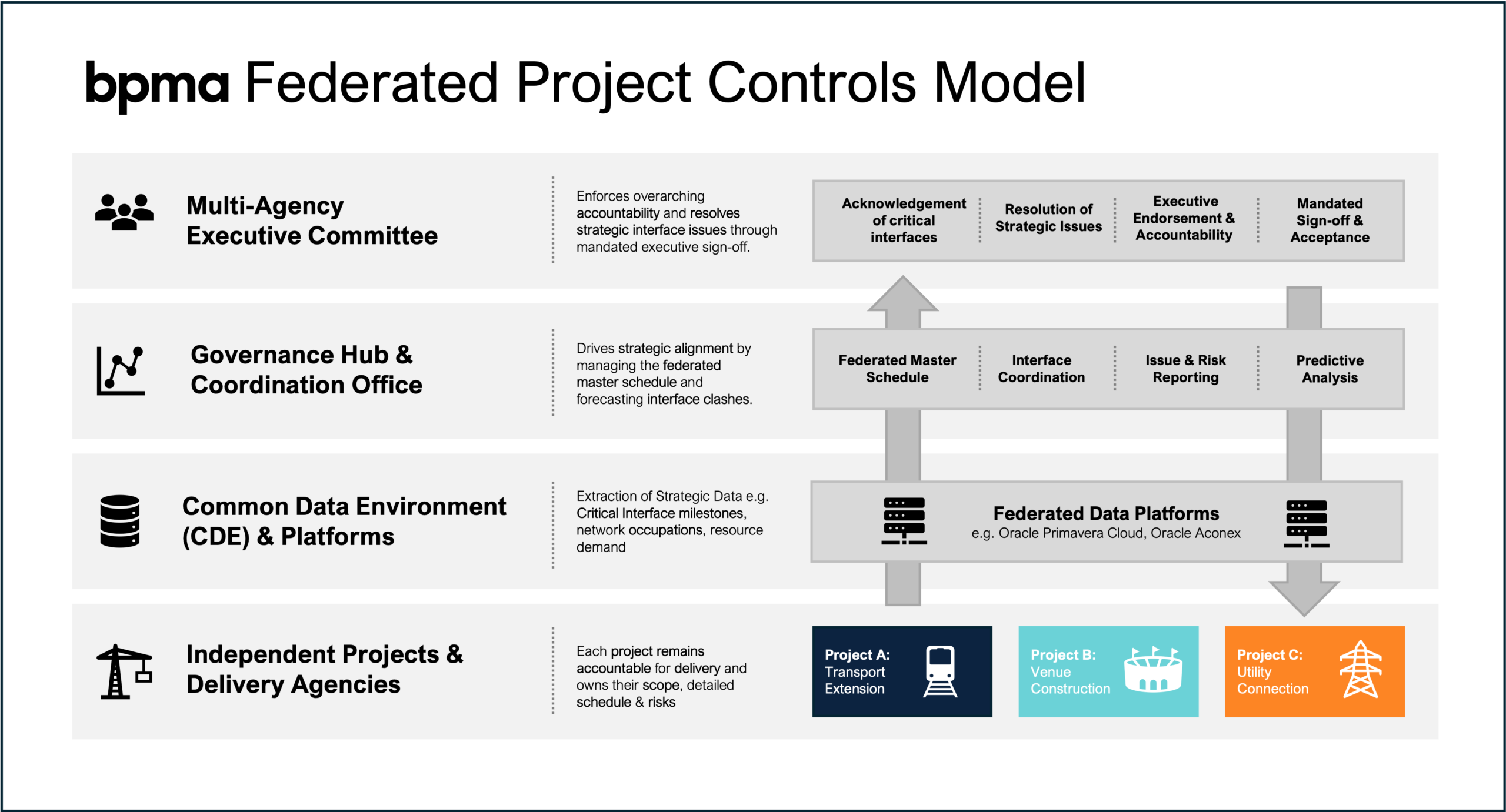
Because interface data spans multiple independent entities, traditional internal project tooling is insufficient. The overarching authority must deploy federated technology platforms—utilising systems like Oracle Primavera (OPC/P6) and Aconex—that span across organisational boundaries. These platforms act as a central ingestion engine, automatically pulling strategic schedule data from each agency and managing technical queries (RFIs) across contract boundaries. Crucially, this allows the coordinating authority to deploy predictive data analytics to forecast interface clashes and resource bottlenecks before they manifest on site.
While individual delivery agencies must incorporate a baseline level of commonality and interface mechanisms into their respective tier-one contracts, the overarching authority’s role is to monitor these arrangements actively. The focus must be on continuously monitoring these strategic interfaces and interdependencies—whether physical, community, or resource-based. When the federated data flags an emerging issue, there must be an effective, pre-defined escalation pathway. This ensures that scheduling conflicts are rapidly elevated to the executive forum and resolved before they can cause a catastrophic or cascading impact on the broader portfolio of projects and the city’s transport network.
Ultimately, technology platforms and the alignment of contracts are simply enablers; overarching executive governance drives alignment.
With this architecture in place, government departments and delivery authorities can move from reactive firefighting to proactive interface control.
Conclusion & Actionable Next Steps
The concurrent delivery of major capital infrastructure across shared regional footprints has fundamentally changed the risk profile of megaprojects. When multiple independent agencies operate within the same physical and operational corridors, the boundaries between those projects become the most critical failure points. As the case studies from Montreal, Berlin, Rio, and Melbourne demonstrate, effective multi-agency delivery is fundamentally a governance and accountability challenge, not just an engineering one.
Engineering can solve complex structural problems, but only rigorous governance can solve clashes bought about by . Government departments and delivery authorities must stop treating adjacent projects as isolated entities and begin managing the overarching regional portfolio through strict executive accountability and federated program controls.
For project sponsors and delivery authorities looking to baseline their current interface risks and establish a federated control environment, there are three immediate, actionable steps:
Do not attempt to consolidate every detailed project schedule. Instead, immediately define the Strategic WBS for the overarching portfolio. Identify and map the exact physical overlaps, shared operational network interfaces, community disruption points, and regional resource constraints that span across independent delivery agencies.
Whilst inter-agency coordination meetings that rely on delegated representatives have a place, there needs to be a mandated governance forum that requires the physical presence of agency CEOs and Accountable Executives. Establish a formal mechanism in which these executives must jointly sign off on interface risks, removing plausible deniability and enforcing strict top-down accountability.
Audit current delivery contracts to ensure downstream tier-one contractors are obligated to capture and report on strategic interfaces. Concurrently, deploy a federated technology stack—utilising platforms like Oracle Primavera (OPC) and Aconex—capable of ingesting this native schedule data, filtering for interface milestones, and automatically flagging cross-agency clashes for executive escalation.
How We Can Assist
bpma is a specialist management consultancy focused on the strategic governance, advanced program controls, and delivery of major capital assets and infrastructure. We partner with government departments, delivery authorities, and tier-one contractors to untangle multi-agency delivery environments.
We specialise in establishing complex governance structures and mapping complex delivery and commercial interfaces across overlapping capital portfolios. By combining deep expertise in project and program management with advanced technical proficiency in federated technology platforms such as Oracle Primavera Cloud (OPC/P6) and Aconex, bpma architects the control frameworks required to execute parallel megaprojects without compromising the operational network.
For more information on our capabilities, experience and services follow the links:


