
Operational Readiness: Ready or Not
Major projects are governed to reach practical completion, but their value only begins when the asset operates reliably in service.
Why does the gap between completion and operations open, and how can it be closed?
By Brent Boden,
November 2026
Executive Summary
Major projects are governed to reach practical completion. Budgets, programmes, contracts and assurance regimes are all built around the moment the works are finished and handed over. Yet a project’s value only begins when the asset operates reliably, safely, and as intended for the people who use it. The period between those two points, when construction teams demobilise and operators and maintainers take over, represents a significant moment of the public’s experience of a project and how it is remembered. It is also, too often, a period that no single party owns.
This paper examines how that gap opens and how to close it. Drawing on our team’s experience, public inquiries, audit reports and industry data across rail, transmission, renewable generation and data centres, it identifies a consistent pattern. The technologies differ, but the failures repeat: testing and commissioning squeezed by a fixed opening date; integration with the wider network or system underestimated; contractually defined acceptance criteria loosened under schedule pressure; operators and maintainers not engaged or resourced for the asset they will run; and requirements not validated by the operator during delivery.
What these failure modes share is timing. Each is set in motion early, in the business case, the procurement strategy or the contract, and surfaces late, during testing, trial operations or the first months of service, when it is most expensive and most visible to fix. The Ottawa Confederation Line, Queensland’s New Generation Rollingstock and the growing delays in connecting new generation to the grid all illustrate the same underlying point: the focus on operational readiness must be maintained throughout the project lifecycle. It must be planned, funded, and contracted from the beginning.
The paper sets out a simple framework for managing the key potential risks. Five readiness streams, covering people, processes, assets and systems, information, and contracts and commercial arrangements, run in parallel with delivery. Four readiness gates, aligned to the business case, contract award, the start of trial operations and the go/no-go decision for service, test whether each stream is on track. Two principles underpin the framework: the operator is a partner from day one, not a recipient at handover; and acceptance criteria, once set, change only through formal governance and never informally under schedule pressure.
The framework is deliberately straightforward. Most of the failures examined in this paper did not occur because the parties lacked sophisticated tools. They occurred because readiness was treated as a late-stage activity rather than a parallel workstream with its own owner, budget and decision points.
“Practical completion is a delivery milestone, not an outcome.”
A rail line that is complete but unreliable, a transmission line that is energised but constrained, or a data centre that is built but prone to outages has not delivered what it was funded to deliver.
1. The Gap Nobody Owns
Every major project has a moment that its governance is designed around. For most capital projects, that moment is practical completion: when the contractor’s works are finished, the asset is handed to the owner, and the delivery organisation’s role begins to wind down. Programme baselines, contractual milestones, incentive payments and assurance reviews all point towards it. The trouble is that practical completion is a delivery milestone, not an outcome. A rail line that is complete but unreliable, a transmission line that is energised but constrained, or a data centre that is built but prone to outages has not delivered what it was funded to deliver.
On most major projects, readiness falls between organisations and between phases. The delivery authority is measured by completing the works on time and within budget. The contractor is paid to reach completion and is exposed to delay damages if it does not. The future operator or maintainer is frequently appointed late, under a separate contract, and has limited influence over design and testing decisions that will shape its operations for decades. Each party acts rationally within its own incentives, and the result is that readiness work is deferred, compressed or traded away when the programme comes under pressure.
The UK National Audit Office captured the pattern in its 2020 review of lessons from major programmes, observing that bodies “often underestimate the complexity of bringing a programme into use” and that operational planning often starts too late, when the programme is nearing completion. The same review identified the shortening of time allotted for operations and systems testing at the end of a schedule as a common symptom of unrealistic planning. Those observations were drawn from British programmes, but the incentives that produce them are common to infrastructure delivery in Australia and elsewhere.
The consequences are not confined to cost. When an asset enters service before it is ready, the failures are public. Passengers are stranded, customers lose supply, and confidence in the project, its sponsors and sometimes the delivery model itself is damaged in ways that are difficult to repair. The following section examines how this has played out across four sectors.
1.1 What Operational Readiness Covers
Operational readiness is the work that turns a completed asset into a functioning service. It has five parts.
1People
Recruiting and training the people who will run and maintain the asset.
2Processes
Writing and rehearsing the procedures they will follow.
3Assets & Systems
Proving the asset works as part of a wider system.
4Information
Handing over what is needed to operate and maintain it.
5Contracts
The contracts, warranties and obligations that govern its life in service.
None of this is new. Experienced operators and asset owners understand it well. The difficulty is structural, not technical.
2. What Goes Wrong: Evidence from Four Sectors
The cases in this section were chosen because they are well documented in public inquiries, audit reports or industry data, and because together they span the sectors where Australia, like much of the world, is investing most heavily: urban and regional rail, transmission and renewable generation, and digital infrastructure. They are not presented as failures of individual organisations. In most of them, capable people made decisions that were reasonable in isolation. The value of the cases lies in what they reveal about the system those people were working within.
Queensland NGR rectification
To upgrade all 75 trains, more than double original expectations
Queensland’s New Generation Rollingstock entered service without meeting disability access standards: corridors too narrow for wheelchairs and some carriages without accessible toilets. The 2018 Commission of Inquiry found staff knew of the design problems before the contracts were signed in 2013, but they weren’t escalated, partly because accessibility was treated as something to fix later. Rectification was completed in July 2024.
THE LESSON A requirement that is known before contract award but not validated during delivery doesn’t go away. It is fixed in service, where it costs the most.
2.1 Rail
The Ottawa Confederation Line is the clearest recent example of a system that entered service before it was ready. The public inquiry into the project, which reported in 2022, found that the City of Ottawa agreed to treat the system as substantially complete in 2019 despite significant outstanding issues, so that it could proceed to trial running “ready or not”. During the summer of 2019, the testing criteria for trial running were changed to make them easier to pass, and the fleet required for revenue service availability was reduced from 17 double cars to 13. The inquiry found that the reduction was driven by the private partner’s difficulty in supplying the full fleet rather than by the ridership analysis cited to justify it. After opening, maintenance resourcing proved inadequate, and the parties had not planned or staffed for the reliability problems that followed. There was no soft launch to allow the operator and maintainer to resolve defects before full service. The inquiry also found considerable political pressure to open, reinforced by successive revenue service dates that the private partner had little realistic prospect of meeting. A derailment in September 2021 led to an extended suspension of service.
Queensland’s New Generation Rollingstock illustrates a different failure: known requirements that were not acted on. The 2018 Commission of Inquiry found that the trains did not comply with disability access standards, with corridors too narrow for wheelchairs and some carriages lacking accessible toilets. Crucially, the inquiry found that staff knew about design problems before the contracts were signed in 2013 but did not escalate them to decision-makers, partly because accessibility was treated as something to fix later. Earlier engagement with the disability sector would have avoided the problem at far lower cost. The rectification program, upgrading all 75 trains, cost $335.7 million, more than double original expectations, and was completed in July 2024.
2.2 Transmission and Renewable Generation
In the energy sector, even if a project’s physical works have been built and tested, it cannot run at full output until it has been proven to perform safely within the wider grid. Before a generator can export, the Australian Energy Market Operator (AEMO) must register it, confirming that its final design and models meet the agreed performance standards. University of Queensland researcher Ruifeng Yan notes that transmission providers are now handling more than 60 projects in the eastern states, and assessing a single connection can take more than a year, while AEMO’s FY26 scorecard finds that design changes and equipment substitutions made after approval can trigger reassessment and rework. Where rail projects tend to squeeze readiness into a compressed schedule, energy projects face the opposite risk. If the programme underestimates AEMO’s timeframes, the operator and maintainer may mobilise too early, and be left to stand down and rehire staff or to face delay claims from subcontractors.
Commissioning remains a material phase in its own right. AEMO’s connections scorecard for June 2026 reports a typical average duration of 4.5 months from commissioning to full output across the 34 projects that reached full output over the preceding 12 months, plus a typical 5.4 months in the registration stage.
Industry experience points to a recurring set of readiness issues on transmission and generation projects: hold-point testing and the demonstration of generator performance standards taking longer than programmed; outage windows for cut-overs and energisation being secured late in a constrained network; protection settings and control system integration being finalised close to energisation; and the transition from the EPC contractor to the operations and maintenance provider, including spares holdings, warranties and the original equipment manufacturer’s support period, being under-planned. On linear projects, landholder access and easement arrangements also carry over into operations and need to be managed as live obligations rather than closed-out construction matters.
AEMO connections pipeline
75.4 GW
of generation and storage in the NEM connections pipeline, up 42% from 53 GW during FY26.
Typical time in each stage
- Application to approval8.6 months
- Registration5.4 months
- Commissioning to full output4.5 months
Median time in proponent implementation rose from 14 to 18 months, and one in three projects in that phase has been there for more than two years.
Source: AEMO NEM Connections Scorecard, June 2026 (12-month typical averages); AEMO media release, 20 July 2026.
2.3 Data Centres
Data centres are a useful comparator because the industry has developed a disciplined approach to commissioning, and because its outage data shows clearly where residual risk lies. Commissioning typically progresses through structured levels, from factory witness testing of equipment through to integrated systems testing of the whole facility under simulated load and failure conditions. That rigour has not eliminated operational risk. The Uptime Institute’s 2025 Annual Outage Analysis found that between two-thirds and four-fifths of major data centre outages involve some human-related cause. Among organisations reporting a major outage linked to human error, 58 per cent cited staff failing to follow procedures, and 45 per cent cited faulty processes or procedures.
The lesson for other sectors is that commissioning the asset is necessary but not sufficient. A facility can pass every integrated systems test and still fail in service because the procedures are incomplete, untested or not followed under pressure. Readiness therefore has to cover people and processes with the same rigour as plant and systems.
Taken together, these cases describe failures that are remarkably consistent across sectors with very different technologies, regulators and delivery models. The next section draws out the common patterns.
3. Five Recurring Failure Modes
Analysing the cases side by side reveals five failure modes that recur regardless of sector. They are not exhaustive, but between them they account for most of the readiness problems documented above. More importantly, they share a common characteristic that has direct implications for how readiness should be governed: each is set in motion early in the project lifecycle and surfaces late.
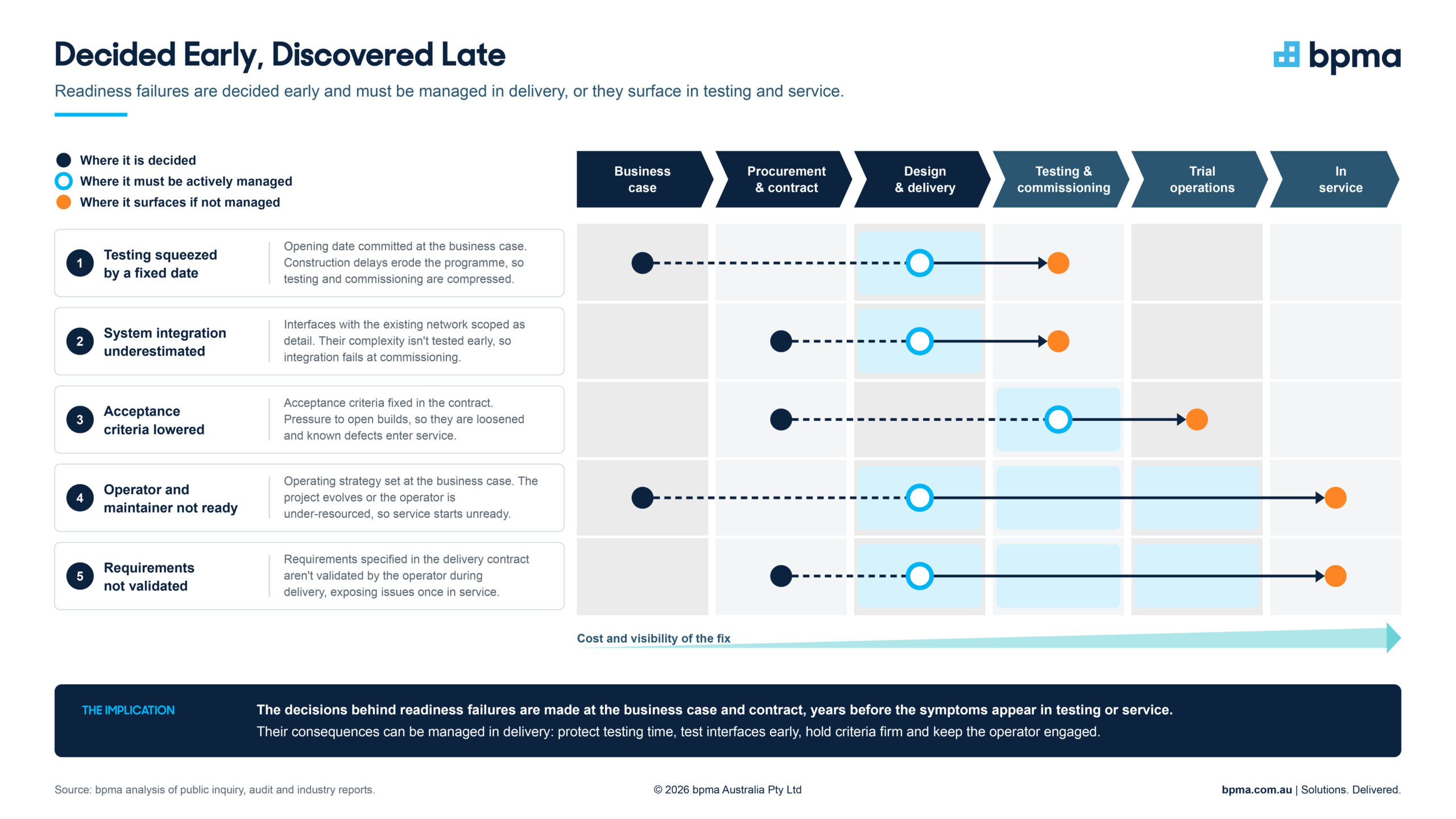
1Testing and commissioning squeezed by a fixed date
When an opening date is fixed early and publicly, before the programme is mature enough to support it, testing and commissioning become the buffer that absorbs every upstream delay. Ottawa shows how this plays out, and the NAO identified the same pattern across UK programmes: activities are run in parallel, testing produces limited useful information, and the time needed to prove the system works is compressed. The decision that causes the problem is made at the business case or announcement stage; its consequences appear in the final months before opening.
2Integration with the wider system underestimated
New assets rarely operate in isolation. A new rail line interfaces with existing signalling, rolling stock and operations; an electricity generator interfaces with a grid whose strength and behaviour it affects. When integration is treated as a technical detail rather than a primary risk, it surfaces late, at registration or commissioning, as AEMO’s connection data shows.
3Acceptance criteria lowered under pressure
Acceptance and trial running criteria are defined in the contract to provide an objective test of whether an asset is ready for service. As pressure to open builds, they become negotiable, and they are loosened at the moment they matter most, allowing known defects into service. Ottawa is the starkest example, but the risk exists on any project where the authority to vary the criteria is unclear or the governance around them is weak.
4Operator and maintainer not ready
An operating strategy is usually defined at the business case, long before the asset is designed. As the project evolves through scope changes, design development and value engineering, the operating model is not always updated to match, and the operator may not be engaged or resourced to manage the readiness of a complex asset. Operating and maintenance organisations need time to recruit, train, write procedures and rehearse on the asset they will actually run. Without it, the consequence is an organisation learning to run the asset in live service, or procedures that are incomplete or not followed, as the data centre outage data shows. The reverse is also a risk: on energy projects where grid connection runs late, an operator mobilised to the construction programme can be left paying for a workforce with no asset to run.
5Requirements not validated
Requirements are specified in the delivery contract, but at that point they are largely theoretical. Accessibility standards, safety regulator requirements, network operator rules and the practical needs of the people who will use and maintain the asset need to be validated continually as the design develops, ideally by the operator who will be accountable for them in service. When that validation does not happen during delivery, gaps are exposed once the asset is in service, when rectification is most expensive. Queensland’s New Generation Rollingstock is the defining Australian example.
THE IMPLICATION
The decisions behind readiness failures are made at the business case and contract, years before the symptoms appear in testing or service.
Their consequences can be managed in delivery: protect testing time, test interfaces early, hold criteria firm and keep the operator engaged.
The pattern shown in Figure 1 explains why readiness so often fails despite the best efforts of capable people. By the time the symptoms appear, the decisions that caused them are years in the past, and the options for fixing them are limited and expensive. Readiness therefore has to be governed from the start of a project, not inspected at the end. The framework in the next section is designed to do that.
4. A Framework for Readiness: Five Streams, Four Gates
The framework proposed here is intentionally simple. Its purpose is not to replace the detailed readiness methodologies that experienced operators and delivery authorities already use, but to give sponsors and boards a clear structure for asking whether readiness is being planned, funded and tested at the right times. It has two dimensions: five readiness streams that run in parallel with delivery, and four gates at which progress across all five streams is tested.
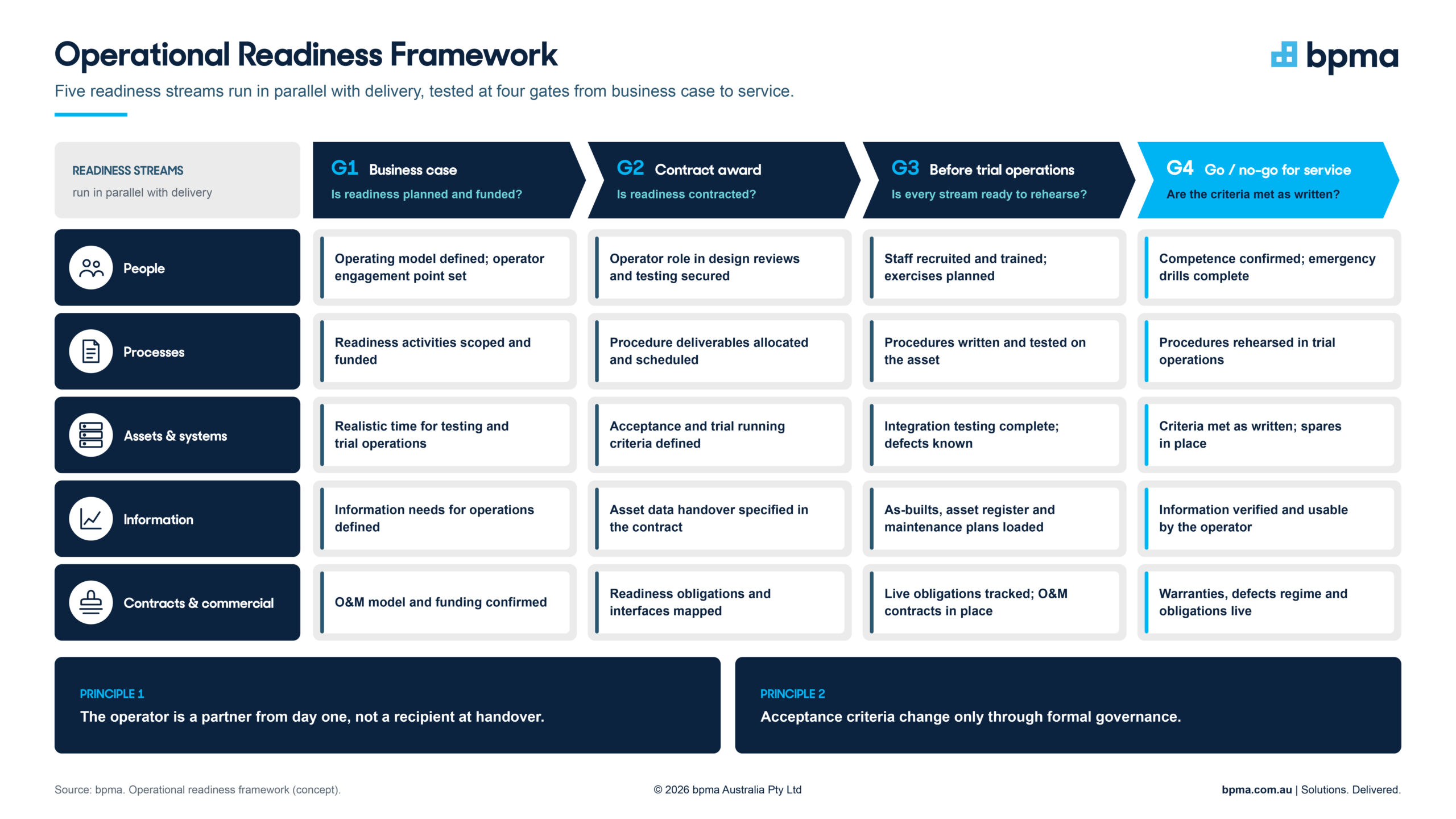
4.1 Five Readiness Streams
The five streams run in parallel with delivery. Each needs an owner, a plan and a budget from the business case onwards, and each is tested at every gate.
People
The operating and maintenance organisation must be designed, recruited, trained and assessed as competent before service begins. This includes frontline staff, control room operators, maintainers and the management team, and it extends to drills and emergency exercises with the relevant emergency services.
Processes
Operating, maintenance and emergency procedures must be written, tested against the actual asset and rehearsed until they are routine. The data centre outage figures make the case for this stream: procedures that exist on paper but have not been tested or embedded are a leading cause of failure even in highly engineered facilities.
Assets & Systems
Testing and commissioning must prove not only that each element works, but that the asset works as part of the wider network or system. This stream includes integration testing, trial running, spares and special tools, and the resolution or formal acceptance of outstanding defects. It is the stream that most projects plan in detail, but often without protecting the time it needs.
Information
Operators and maintainers need accurate as-built records, a populated asset register, maintenance plans, and digital asset information in a form their systems can use. Information that arrives late or incomplete forces the operator to rebuild it in service, often while also managing early-life defects. This stream connects readiness directly to asset management and to the information management standards many owners now specify.
Contracts
The contractual arrangements that govern life in service, including operations and maintenance contracts, warranties, defects liability, spares agreements and the obligations transferred from the delivery phase, must be live, understood and actively managed from the first day of operations. This stream is often overlooked because it sits between the delivery and operations organisations, and because many of the obligations it carries are already running before construction finishes.
4.2 Four Readiness Gates
At each gate, an independent review tests all five streams against a single question.
G1
Business case
Is readiness planned and funded?
The business case should define the operating model, identify when the operator and maintainer will be engaged, allow realistic time for testing, commissioning and trial operations, and fund the readiness activities in each stream. Announcing an opening date without this analysis is the origin of the first failure mode.
G2
Contract award
Is readiness contracted?
Acceptance and trial running criteria should be defined precisely, readiness deliverables and obligations should be allocated to the parties best placed to deliver them, and the operator’s role in design reviews and testing should be secured. Section 5 examines this gate in more detail.
G3
Before trial operations
Is every stream ready to rehearse?
An independent review should test all five streams against the criteria set at Gate 2. This is the last point at which gaps in people, processes, or information can be addressed without affecting service, and the review should be empowered to recommend deferring trial operations.
G4
Go / no-go for service
Are the criteria met as written?
The criteria should be those agreed at Gate 2, assessed objectively, and any proposal to vary them should be made transparently through formal governance, with the risks of proceeding set out for the decision-maker. Where practical, a staged opening or soft launch reduces the consequences of residual issues, a lesson the NAO drew from several programmes introduced all at once.
4.3 Two Governing Principles
Two principles underpin the framework and address the root causes identified in Section 3.
PRINCIPLE 1
The operator is a partner from day one, not a recipient at handover.
A partner, not a recipient
The organisation that will run and maintain the asset should be engaged from the business case onwards, with a defined role in requirements, design reviews, testing and acceptance. Where the operator has not yet been appointed, the owner should hold that role on its behalf.
PRINCIPLE 2
Acceptance criteria change only through formal governance.
Criteria are not a schedule buffer
Schedule pressure is not a reason to vary them. If a variation is justified, it should be made transparently, with the decision-maker understanding and accepting the consequences.
Neither principle is complicated. Their value lies in applying them consistently, particularly when a project is under pressure to open.

“Gate 2 is the point at which readiness is either secured or quietly left to chance.”
5. Building Readiness into the Contract
Many of the failure modes examined in this paper are ultimately contractual. Readiness depends on obligations, criteria and interfaces that must be defined before the works begin if they are to be enforceable when they matter. Gate 2 is therefore the point at which readiness is either secured or quietly left to chance.
The first priority is to define completion, trial running, and acceptance criteria precisely. Vague criteria, or those that leave room for interpretation about what constitutes satisfactory performance, will be renegotiated under pressure. Criteria should specify what is to be demonstrated, over what period, under what conditions and to whose satisfaction, and the contract should set out how they may be varied and by whom.
The second is allocating readiness obligations. Training, the provision of operating and maintenance manuals, the handover of asset information, spares and special tools, and participation in trial operations are all deliverables that should be scheduled, resourced and linked to the payment and completion regime in the same way as the physical works. Where the operator is a separate party, the interfaces between the delivery contract and the operations contract need to be mapped explicitly, so that obligations do not fall between them.
The third is the recognition that many operational obligations are live long before operations begin. Obligations relating to approvals, environmental conditions, stakeholder commitments, reporting and the preparation of operational documentation typically arise during delivery. An incoming operator that assumes its obligations start at handover will find that some have already been missed. This is the link between operational readiness and the broader discipline of contract compliance examined in bpma’s paper Managing Contractual Obligations: The Other Project.
Finally, the defects liability and warranty regime should be designed with the operator in mind. Defects often emerge in the early months of service, and the operator needs clear, fast routes to rectification, supported by spares and manufacturer support. Standard form contracts such as NEC4 provide useful mechanisms for collaborative management of these issues, but they are only as effective as the criteria and obligations they apply.
6. Getting Started
Readiness can be strengthened at any stage of a project, although the options narrow as delivery progresses. The appropriate first steps depend on where a project currently sits.
- 1. Strategy
-
Set readiness up before the opening date is fixed.
- Define the operating model and the point at which the operator and maintainer will be engaged.
- Build realistic durations for testing, commissioning and trial operations into the programme.
- Fund readiness activities as a distinct line in the cost estimate.
- Avoid announcing an opening date until the programme can support it.
- 2. Procurement
-
Write readiness into the contract before award.
- Review the draft contract against the five readiness streams.
- Confirm that acceptance and trial running criteria are precise and that the process for varying them is clear.
- Allocate readiness deliverables explicitly and secure the operator’s role in design reviews and testing.
- 3. Delivery
-
Give readiness an owner while there is still time to act.
- Establish a readiness workstream with its own owner, plan and reporting line to the project board, if one does not already exist.
- Map the operational obligations that are already live.
- Commission an independent readiness assessment well before Gate 3, while there is still time to act on its findings.
- 4. Transition
-
Protect the criteria and rehearse before opening.
- Hold firm on the acceptance criteria.
- Plan and protect a trial operations period that rehearses failure and emergency scenarios, not only normal running.
- Where practical, consider a staged opening that allows residual issues to be resolved before full service.
Set readiness up before the opening date is fixed.
- Define the operating model and the point at which the operator and maintainer will be engaged.
- Build realistic durations for testing, commissioning and trial operations into the programme.
- Fund readiness activities as a distinct line in the cost estimate.
- Avoid announcing an opening date until the programme can support it.
Write readiness into the contract before award.
- Review the draft contract against the five readiness streams.
- Confirm that acceptance and trial running criteria are precise and that the process for varying them is clear.
- Allocate readiness deliverables explicitly and secure the operator’s role in design reviews and testing.
Give readiness an owner while there is still time to act.
- Establish a readiness workstream with its own owner, plan and reporting line to the project board, if one does not already exist.
- Map the operational obligations that are already live.
- Commission an independent readiness assessment well before Gate 3, while there is still time to act on its findings.
Protect the criteria and rehearse before opening.
- Hold firm on the acceptance criteria.
- Plan and protect a trial operations period that rehearses failure and emergency scenarios, not only normal running.
- Where practical, consider a staged opening that allows residual issues to be resolved before full service.
7. Conclusion
Australia’s infrastructure pipeline will deliver new rail lines, transmission networks, renewable generation and digital infrastructure at significant pace and scale. Each of these assets will be judged not by the date its construction was completed, but by how well it performs from its first day in service. The evidence from Ottawa, Queensland and Australia’s grid connection process shows that readiness failures are rarely caused by a lack of technical capability. They stem from governance and commercial arrangements that treat readiness as the last step in delivery rather than a parallel workstream with its own owner, funding, and decision points.
The framework in this paper offers a simple way to correct that. Five readiness streams ensure that people, processes, assets and systems, information and contracts are all prepared together. Four gates ensure that readiness is planned at the business case, secured at contract award, tested before trial operations and confirmed before service. Two principles, treating the operator as a partner from day one and holding acceptance criteria firm, address the root causes that recur across every sector examined.
None of this requires new technology or new institutions. It requires sponsors, delivery authorities and boards to recognise that the gap between completion and operations is where a project’s reputation is made or lost, and to ensure that someone owns it from the start.
Sources
- Ottawa Light Rail Transit Public Inquiry, Final Report, 2022. Archives of Ontario
- CTV News, “10 takeaways from the Ottawa LRT inquiry final report”, 2022. ottawa.ctvnews.ca
- National Audit Office (UK), Lessons learned from Major Programmes, HC 960, 20 November 2020.
- Commission of Inquiry into the New Generation Rollingstock Train, Final Report, 2018 (Queensland). traininquiryngr.qld.gov.au
- The New Daily, “Queensland trains that breached disability laws were flawed ‘from day one’”, 10 December 2018. thenewdaily.com.au
- Queensland Government, “Back on track: $335.7 million train accessibility upgrade program now complete”, 30 July 2024. statements.qld.gov.au
- Australian Energy Market Operator, Connections Scorecard, June 2026. aemo.com.au
- Australian Energy Market Operator, “NEM connections scorecard reflects record result for FY26”, media release, 20 July 2026. aemo.com.au
- ABC News, “Investors, experts call for action to remove bottlenecks slowing the renewables rollout”, 11 August 2026. abc.net.au
- Uptime Institute, Annual Outage Analysis 2025, as reported in The Register, 7 May 2025. theregister.com
This paper provides general commentary and a framework for discussion. It does not constitute legal, engineering or commercial advice for any specific project.
How We Can Assist
bpma is a specialist management consultancy focused on the strategic governance, commercial management and delivery of major capital assets and infrastructure. We partner with government departments, delivery authorities, operators and tier-one contractors to make sure that the asset that is completed is also ready to operate.
We assess operational readiness across the five streams and four gates set out in this paper; build readiness deliverables, acceptance criteria and obligations into contracts before award; and provide independent readiness reviews ahead of trial operations and the go/no-go decision for service.
We connect readiness to the disciplines that sustain it in service: asset management, contract management and the transfer of obligations from delivery to operations.
For more information on our capabilities, experience and services, follow the links:


